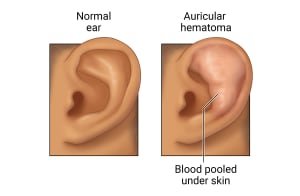
Auricular hematoma is a pocket of blood under the skin in the top half of the ear. It most often happens due to injury from an accident, a fight, or sports. It’s a common problem in boxing, wrestling, and other rough sports. It can also be caused by an infection from an ear piercing.
How to say it
or-RIK-yoo-ler
HEE-muh-TOH-muh
Auricular hematoma is often treated by draining the blood with a needle or small cut (incision). This helps the ear skin heal in a normal shape. Untreated auricular hematoma can lead to cauliflower ear. This is when the ear tissue gets thick and looks swollen and lumpy. It can be treated with surgery.
Home care
-
Plan to rest at home as needed.
-
Don’t do vigorous activities or heavy lifting.
-
Use pain medicines as instructed (see below).
-
If you had the auricular hematoma drained, a bolster dressing is put on your ear. It uses small rolls of material firmly wrapped to hold your ear skin in place. This is so the area can’t fill with blood again.
-
If you are prescribed antibiotic medicine, take it exactly as instructed. Don’t miss any doses. Don’t stop taking it, even if you feel better. Finish all the medicine.
-
Keep the ear and dressing clean and dry for 7 days. This will help healing and prevent infection. Don’t wash your hair, shower, or go swimming.
-
Use cold packs to help reduce pain and swelling. Wrap a cold pack or baggy of ice in a thin towel or cloth. This is to protect your skin. Put it on the ear. Hold it in place for 15 minutes. Remove for 15 minutes. Repeat as needed.
-
In bed, keep your head elevated with pillows. This is to help reduce swelling and let fluid drain from the ear.
-
After your ear heals, wear headgear or padding to protect your head and ears if you play sports.
Medicine for pain
You can use over-the-counter medicines to control pain. These include acetaminophen, ibuprofen, and naproxen. Ask your doctor what pain medicines are safe for you. You may be told not to take some medicines if you have diabetes, liver or kidney disease, or stomach ulcers. Tell your doctor if you take blood-thinner medicine.
Don’t take more than 4,000 mg of acetaminophen in 24 hours. It can harm your liver. Check medicine labels to see how much they contain.
Your doctor may prescribe pain medicine. Take this exactly as directed. Don’t drive or use machines. Pain medicine can make you sleepy and slow your movement.
Follow-up care
Follow up with your doctor as advised. The ear may need to be drained again.
When to get medical advice
Contact your doctor if you have any of these:
-
Fever
-
Pain or swelling that gets worse
-
Redness, heat, or fluid leaking from the area
Date Last Reviewed: 10/31/2024
© 2000-2026 The StayWell Company, LLC. All rights reserved. This information is not intended as a substitute for professional medical care. Always follow your healthcare professional's instructions.
Personalized care starts with the right provider
Search by specialty, location, and more.
FIND A DOCTORRelated Articles
Cauliflower Ear
Cauliflower ear is a condition that makes the outer ear look swollen and lumpy (like a cauliflower). It can occur after a direct hit to the ear.
Deviated Septum
A deviated septum may cause congestion, problems with breathing, or nasal discharge. Here's what to know about this condition.
Ear, Nose, and Throat Facts
Read on for a detailed look at the parts that make up the ear, nose, and throat.
Fluency Disorder
A person with fluency disorder has trouble speaking in a fluid or flowing way. They may repeat parts of words (stutter) or speak fast and jam words together (clutter).