Definition
Autosomal Dominant Inheritance
Genes are the blueprints for making proteins. Our bodies need proteins to develop and work in the right way. Most genes come in pairs. One is inherited from the mother and the other from the father. Genes inherited from our biological parents are expressed in specific ways. One of these basic patterns is called autosomal dominant inheritance.
What is autosomal dominant inheritance?
There are 2 types of chromosomes:
-
Sex chromosomes. These determine male or female sex.
-
Autosomes. These are all of the other chromosomes (pairs 1 through 22).
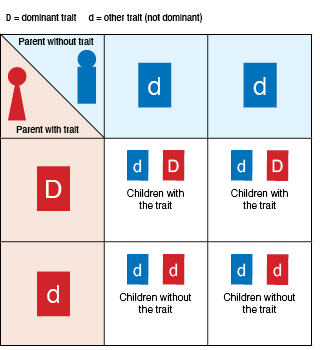
Autosomal inheritance of a gene means that the gene is located on one of the autosomes. This means that males and females are equally likely to inherit the gene. "Dominant" means that a single copy of the gene can cause a certain trait, such as brown eyes instead of blue eyes. When a parent has a dominant gene, there is at least a 50% chance that any child they have will also have the trait.
There are 4 possible combinations in the children (see figure). These combinations are possible every time a pregnancy occurs between these two people. The gender of the child (whether it is male or female) does not matter. The chance is 50/50 for them to inherit the autosomal genes.
Some dominant genes can have variable expression. This means that some people have milder or more intense traits than others. Another important characteristic of dominant genes is that, in some cases, they can have reduced penetrance. This means that sometimes a person can have a dominant gene copy but not show any signs of the gene. The concept of reduced penetrance is particularly important in the case of autosomal dominant cancer susceptibility genes. If a person has inherited a cancer susceptibility gene, it does not mean they will automatically develop cancer. It simply means that the person has inherited a mutation in a gene that gives them a higher chance of getting cancer than someone without the mutation.
Examples of conditions involving autosomal dominant inheritance are:
-
Marfan syndrome.
-
Neurofibromatosis.
-
Achondroplasia.
Online Medical Reviewer: Dan Brennan MD
Online Medical Reviewer: Raymond Kent Turley BSN MSN RN
Date Last Reviewed: 08/31/2025
© 2000-2026 The StayWell Company, LLC. All rights reserved. This information is not intended as a substitute for professional medical care. Always follow your healthcare professional's instructions.
Personalized care starts with the right provider
Search by specialty, location, and more.
FIND A DOCTORRelated Articles
Autosomal Recessive Inheritance
Detailed information on autosomal recessive genes.
How Genes Cause Cancer
Genes that have alterations, or mutations, can cause cells to become cancerous. Some mutations are inherited and others are "acquired," happening by chance over time.
Hereditary Colorectal Cancer Syndromes: Familial Adenomatous Polyposis (FAP)
FAP is a syndrome characterized by a large number of noncancer (benign) polyps in the colon and rectum. Without treatment, a person with FAP has a nearly 100% risk of colorectal cancer.
Breast Cancer: Chemotherapy
Chemotherapy may be able to cure breast cancer. If a cure isn't possible, chemotherapy may help keep the cancer from growing or spreading. Or it may help ease symptoms caused by cancer and improve your quality of life.