Management
Tips for Safer Lifting
An incorrect lifting method is often a main cause of back strain and injury. A back injury caused by lifting may result in these problems:
- Muscle injury. Stress on the lower back muscles can happen when you get out of correct position while lifting. Too much stress on the muscles can cause strain, pull, or small tears.
- Disk injury. A disk is a type of cushion between the bones of the spine. A back injury can cause a disk to bulge or rupture and then press on nearby nerves to cause pain and discomfort.
- Joint injury. This type of injury can happen when you use incorrect lifting methods, even when the item you're lifting is relatively light.
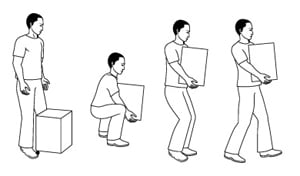
These tips can help prevent injury when lifting objects:
- Face the object you want to lift and, with your back straight, move your whole body to protect your back. Bend your knees and hips, not your back. Don't bend or lift if you are off balance or if your back is twisted. If needed, bend one knee to kneel down, with the other foot flat on the floor.
- Tilt the object to one side, if possible, so it can be lifted from underneath.
- Keep the object close to your body.
- Support your back by tightening and holding in your belly muscles.
- Use your arms, legs, and buttocks to lift the object. Lift with your legs, not your back. Don't twist.
- Keep a firm grip on the load, and keep your arms and elbows close to the body while lifting.
When carrying the load, keep it close to your body. Don't twist your back. Keep your shoulders and hips in line with each other. When changing direction, shift the position of your feet and turn your entire body.
When you're ready to set the load down, bend your knees to lower it rather than bending at the waist. If the object is to be placed on a shelf, bench, or table, set it on the edge of the surface and push it into the desired position.
Remember that it's better to ask for help to lift a heavy object than to injure your back.
Author: Ignite Staff
Online Medical Reviewer: Michelle Anderson DNP
Online Medical Reviewer: Mike Murphy
Date Last Reviewed: 08/31/2025
© 2000-2026 The StayWell Company, LLC. All rights reserved. This information is not intended as a substitute for professional medical care. Always follow your healthcare professional's instructions.
Relief starts here
From sports injuries to joint replacement—we've got you covered.
FIND AN ORTHOPEDIC SPECIALIST
Personalized care starts with the right provider
Search by specialty, location, and more.
FIND A DOCTORRelated Articles
How to do a pelvic tilt exercise
The pelvic tilt exercise uses subtle motions that build strength by isolating, tightening, and holding muscle positions.
Hip Replacement Surgery
Hip replacement (total hip arthroplasty) is surgery to replace a worn out or damaged hip joint. The surgeon replaces the old joint with an artificial joint (prosthesis). This surgery may be a choice after a hip fracture or for severe pain because of arthritis.
A Rotation That Starts at the Waist
This back exercise improves strength and flexibility of your spine. Start by sitting in a sturdy chair, with your feet flat on the floor.
Knee Ligament Repair or Reconstruction
Ligaments surround a joint to give it support and limit its movement. A torn ligament severely limits knee movement. Surgery is a choice to repair a torn ligament if other treatment does not work.