Treatment
Intradiscal Procedures for Back Pain
Sometimes back pain comes from the jelly-filled discs between each vertebrae that help make up your spine.
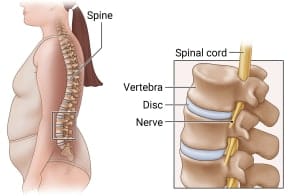
The spine's 33 bony vertebrae are linked together in a way that allows the spine to bend and move. There are 24 vertebra that come in contact with one another. Between each of them is a flat, jelly-filled disc. This acts as a shock absorber for the spine. When the discs bulge (herniate) out of their space and become displaced, it presses on spinal nerves causing back pain or pain radiating to the legs. Bulging discs can occur anywhere in the spine but are more common in the lower back. One treatment option you may have is an intradiscal procedure. This may ease the pain.
Intradiscal procedures are generally considered experimental or investigational. Medical opinion on them varies a lot. Several small studies have said that intradiscal procedures are relatively safe ways to ease back pain. But many experts say they haven't seen much proof that these procedures really work. Some research shows good results for certain procedures. But other research shows less of an effect. For some procedures, more research needs to be done. And the research needs to be done with a larger number of people.
Many intradiscal procedures can be done on an outpatient basis. They are slightly invasive. This generally means you'll have less pain from the treatment itself and a speedier return to daily life. But before having such a procedure, you'll want to talk with your doctor about the risks and benefits in detail. The healing process may limit your movements. So be sure you understand what you can and can't do after a procedure. Also check to see whether your insurance company covers the specific procedure you're thinking about.
Types of intradiscal procedures
Percutaneous mechanical disc decompression
During this procedure, your surgeon removes some of the tissue from the center of the bulging disc that is causing you pain. The goal is to remove as little material as possible. In this way, the disc stays stable. The surgeon, with X-ray guidance, uses a needle to reach the disc and remove the extra material from the jelly-like center of the disc. This is known as the nucleus pulposus. It's usually done under local anesthesia in a doctor's office or an outpatient surgery center. Your movement may be limited for a while after the procedure. But healing is faster than with an open surgery.
Percutaneous thermal intradiscal procedures
This includes intradiscal electrotherapy or electrothermal therapy.
For this treatment, the doctor inserts a wire electrode near the disk. Electric current generates heat in the wire. The heat shrinks the disc to ease pain. Often, this procedure isn't covered by insurance.
Laser disc decompression
Another treatment takes some of the fluid out of the disc that is causing pain. Laser treatments have been used to deflate a disc. The doctor inserts an optical fiber into the disc. The heat created causes a small amount of the water content in the center of the disc to turn into vapor. The heat may reduce pain by affecting the chemical structure and decreasing the pressure in the disc.
Risks of the procedures
Like any surgery, these procedures carry some risks:
- Infection
- Damage to the disc
- Damage to nearby tissues and nerves
- Failure to resolve pain or the pain gets worse
- Need for further surgery
Alternative approaches
The first-line treatment for degenerative disc disease is conservative care. This may mean taking anti-inflammatory medicines or other pain medicines. And trying physical therapy, exercise, and behavior modification. Many cases of lower back pain go away on their own with time. Intradiscal procedures are often used when conservative care has not been effective.
Author: Ignite Staff
Online Medical Reviewer: Anne Fetterman RN BSN
Online Medical Reviewer: Heather M Trevino BSN RNC
Online Medical Reviewer: Rita Sather RN
Date Last Reviewed: 01/31/2024
© 2000-2026 The StayWell Company, LLC. All rights reserved. This information is not intended as a substitute for professional medical care. Always follow your healthcare professional's instructions.
Relief starts here
From sports injuries to joint replacement—we've got you covered.
FIND AN ORTHOPEDIC SPECIALIST
Personalized care starts with the right provider
Search by specialty, location, and more.
FIND A DOCTORRelated Articles
Nerve Blocks
Neural blockades, commonly called nerve blocks, are procedures that can help prevent or manage many different types of intractable pain.
TENS Therapy
Transcutaneous electrical nerve stimulation, or TENS, offers pain relief for some people by sending low-voltage electrical current into the body.
Nerve Block for Pain
If you don't get relief from standard pain relievers, your healthcare provider may suggest injecting pain-relieving medicine into the site of the affected nerve.
Corticosteroid Shots
Corticosteroid injections can treat many skeletal, muscular, and spinal conditions. Some of these injections can be done by your health care provider during a routine clinic visit. Others need a referral to a pain specialist.