Fitness
Exercise and Target Heart Rate
The fitness world is full of gadgets. Some are helpful, and many are more trouble than they are worth. But one device you might find useful is a heart rate monitor.
The key to cardiovascular fitness is getting a good, but safe, aerobic workout. Heart rate monitors, which track your heart rate while you exercise, can help you do that with ease. They range from pretty simple devices that show at a glance how many times per minute your heart is beating to devices that record how long you were exercising at your target heart rate.
Your target heart rate is important information to know regardless of your fitness level.
Here's a simple way to find your maximum and target heart rates: Subtract your age from 220 to figure out your maximum heart rate. For instance, if you are 35, your maximum heart rate is 185 beats per minute. Your target heart rate is 50% to 85% of that number, or 93 beats to 157 beats per minute. These numbers are based on a healthy adult.
Feel your pulse
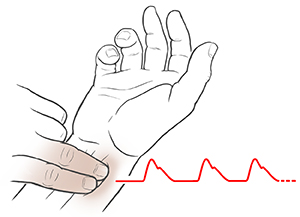
Now that you know what your target heart rate should be, you can calculate your heart or pulse rate using a watch. To take your wrist pulse, also known as a radial pulse, hold one hand in front of you, palm upward. Gently place the index and middle fingers of the other hand near the thumb-side of the wrist to feel the pulse. You should not need to press hard to feel the pulse. It is generally better to check the radial pulse, but if for some reason you need to check your neck, or carotid pulse, be sure to check only one side at a time. Never press hard. Count the beats for 30 seconds, then multiply this number by 2 to give you the beats per minute.
This method is fine for many exercisers. If you like the idea of having that information instantly available in the middle of a workout, you might want to buy a monitor.
Heart rate monitors aren't as exact as an electrocardiogram (ECG) test, but they can be very accurate. The least costly models have two parts: a small transmitter mounted on a belt that wraps around your chest, and a device like a wristwatch that displays the numbers. There are no wires. The watch-like monitor picks up signals from the transmitter. More modern devices have the ECG recorder embedded in a watch and watchband. It can not only detect heart rate but also record the heart rhythm.
If you have an irregular heart rhythm, heart rate monitors are not accurate for you. If you aren't aware of this, your results can cause panic. The sensors are not sensitive enough to tell the difference between early heartbeats and may calculate a very low heart rate. The sensors may also pick up vibrations from a moving car or an electric toothbrush and calculate a high heart rate in error. Don't panic. Take your pulse manually, as above, to see if the monitor is accurately counting your pulse. Or check with your health care provider to make sure you are OK.
Modern watches can detect abnormal heart rhythms with more accuracy than just heart rate monitors. However, the accuracy of these newer wearable devices is not yet known. But if you feel extremely tired or weak, have chest pressure, feel like you can't get enough air, or feel faint, get medical care right away by calling 911.
Getting feedback
Whether you walk, jog, run, bicycle, or use stationary bikes, rowers, or ski machines, you can see some real benefits. Feedback on your progress is an important support when you exercise. You'll find that over time you'll be able to perform longer within your target heart rate range. You'll also notice that as you get more in shape, you can do some tasks at a lower heart rate, or run even farther or faster at the same heart rate.
Too often, though, beginners can push too hard. They think exercise has to hurt, and they'll work out at a pace that's hard to keep up. A monitor helps them set limits so they don't overdo it.
If you are a newcomer to exercise, check with your health care provider before starting a fitness program. Your provider also can help you find what target heart range is best for you based on your health.
Run up your pulse
Your heart rate will change depending on what type of exercise you are doing. For example, weight training can get your heart rate up to about 70% of its upper limit. It won't stay that high for long because lifting weights isn't a constant effort.
On the other hand, people who ride stationary bikes can generally maintain 75% of their target heart rate for about 30 minutes of a 40-minute workout.
Runners who are in great shape also will be able to maintain a high heart rate for long periods, close to 80% to 85% for miles at a time.
Author: Davis, Otho
Online Medical Reviewer: Stacey Wojcik MBA BSN RN
Online Medical Reviewer: Steven Kang MD
Online Medical Reviewer: Terri Koson DNP RN ACNP
Date Last Reviewed: 02/28/2025
© 2000-2026 The StayWell Company, LLC. All rights reserved. This information is not intended as a substitute for professional medical care. Always follow your healthcare professional's instructions.
Personalized care starts with the right provider
Search by specialty, location, and more.
FIND A DOCTORRelated Articles
Strength-Training Myths
Taking time each week to build your strength can help you live a more healthy and independent life. Read on to dispel myths and to get the facts about strength training.
Staying Fit the Old-Fashioned Way
The major culprit behind the U.S. decline in physical activity may be our own high-tech and increasingly sedentary lifestyle.
Exercising in the Cold
Cold weather doesn't have to put a freeze on your outdoor exercise program. If you take precautions, you can still work out when the weather turns chilly.
Conditioning Strategies for Peak Athletic Performance
Invest some time at the gym to get your muscles in peak condition.