Definition
Understanding Skull Base Tumors
Your ability to run, jump, write with a pen, laugh, and experience pain all start in the brain. The brain is a mass of soft tissues and nerve cells attached to the spinal cord that sends messages throughout the body to let you move and feel. The brain is divided into several parts, all protected by the skull.
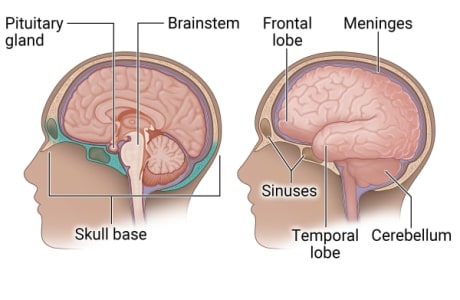
At the base of the skull is bone that supports four brain components—the frontal lobe, temporal lobe, brain stem, and cerebellum.
The skull base offers support from the bottom of the brain. Think of it as the floor of the skull, where the brain sits. Five bones make up the skull base. From front to back they are:
- Frontal
- Ethmoid
- Sphenoid
- Temporal
- Occipital
Skull base tumors
Tumors can form at the base of the skull. Or they can extend to the base of the skull after starting in another part of the body. This is called metastasis. Skull base tumors are often close to critical areas of the brain. This can make surgery hard to do and potentially dangerous.
Skull base tumors may form in many areas, including the:
- Meninges, the outer covering of the brain
- Sinuses
- Pituitary gland
- Skull bone itself (osteosarcoma)
Symptoms of skull base tumors
Symptoms will vary, depending on the origin and site of the tumor. All symptoms tend to start slowly and get worse gradually over time.
Tumors growing from the base of the cranium into the nose can cause symptoms like that of a chronic sinus infection:
- Runny nose
- Stuffy nose
- Nosebleeds
- Trouble breathing through the nose
- Pressure in the face
Other types of skull base tumors may cause these symptoms:
- Blurry or double vision
- Vision loss
- Numbness in the top teeth
- Bulging eyes
- Tearing
- Loss of smell
- Loss of hearing
- Headaches
- Seizures
- Nausea
- Vomiting
- Changes in mental status
- Pain in the ear
Diagnosis
Skull base tumors can be diagnosed through:
- Physical exam
- Imaging tests, like MRI, PET, and CT scans
- Biopsy
Treatment
Skull base tumors are hard to treat because of their location deep inside the brain. Treatment typically includes surgery, when possible, followed by radiation therapy. Chemotherapy is sometimes used, too.
New surgical methods allow the surgeon to reach and remove skull base tumors that have been nearly unreachable through conventional surgery. One method is the endoscopic endonasal approach. It lets surgeons take out tumors through the nose. Another method is endoport surgery. The surgeon removes the tumor through a straw-like tube inserted in a tiny hole drilled in the skull. The tube is threaded into deep regions of the brain that were previously difficult, if not impossible, to reach. These and other minimally invasive procedures have led to better success rates in treating skull base cancers, with fewer complications and side effects.
Author: Ignite Staff
Online Medical Reviewer: Esther Adler
Online Medical Reviewer: Raymond Kent Turley BSN MSN RN
Date Last Reviewed: 08/31/2025
© 2000-2026 The StayWell Company, LLC. All rights reserved. This information is not intended as a substitute for professional medical care. Always follow your healthcare professional's instructions.
Early detection can make all the difference
Our specialists treat migraines to movement disorders.
Find a Neurologist
Personalized care starts with the right provider
Search by specialty, location, and more.
FIND A DOCTORRelated Articles
Anatomy of the Brain
The brain is an important organ that controls thought, memory, emotion, touch, motor skills, vision, respiration, and every process that regulates your body.
Neurology
Neurology is the branch of medicine that is concerned with the study and treatment of disorders of the nervous system.
Spinal Arteriovenous Malformations
Arteriovenous malformations is the abnormal formation of veins and arteries. It can develop in the fetus or newborn baby. Learn more about this condition, including causes, diagnosis, and treatment.
Bacterial Meningitis
Bacterial meningitis is an infection of the membranes that protect the spinal cord and brain. Learn more about this condition, including cause, symptoms, diagnosis, and treatment.