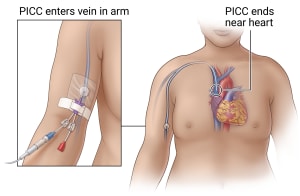
You have a peripherally inserted central catheter (PICC) in place. This is the flexible tube in a vein in your arm that leads to a large vein near your heart. It is used to give you medicines, fluids, or nutrition as needed. Below is what to expect when it’s time to have your PICC removed.
Before PICC removal
Your healthcare team will tell you when your PICC can be removed. Ask questions and tell them any concerns you may have.
During PICC removal
-
You may be asked to lie down. You will rest your arm on a pillow or table.
-
The dressing over your PICC will be removed.
-
You will be asked to stay still. You may be asked to hold your breath for a short time when the PICC is removed.
-
The healthcare provider will gently pull the PICC line out. You may feel mild pressure or a pulling feeling.
-
When the PICC is out, they will apply gauze and press on the site. This is to help stop bleeding. They will keep pressure on the site for as long as needed.
-
They will then put a sterile bandage on the site. This is to protect it and let it heal.
After PICC removal
Follow all instructions from your provider.
-
Keep the site clean and dry for
24 to 48 hours . After that, you can remove the bandage. -
Don’t shower for
24 to 48 hours . When you shower, wash the PICC site gently. Pat your skin dry. Don’t rub. -
Watch for signs of infection. These include fever, pain, redness, warmth, swelling, or fluid leaking.
-
Don’t lift anything heavy or do any strenuous exercise for
48 hours . -
Don’t immerse the PICC site in water for
1 to 2 weeks . This means don’t take a bath, or go in a pool or hot tub.
After the PICC site heals, you may have a small scar.
When to contact your doctor
Contact your doctor if you have any of these:
-
Bleeding at the PICC site that won’t stop
-
Pain at the PICC site
-
Signs of a blood clot, such as swelling and pain in the arm where the PICC was
-
Signs of infection at the PICC site, such as redness, warmth, swelling, or fluid leaking
-
Fever of 100.4°F (38°C) or higher, or as advised by your doctor
-
Chills
-
Trouble breathing
Date Last Reviewed: 01/31/2025
© 2000-2026 The StayWell Company, LLC. All rights reserved. This information is not intended as a substitute for professional medical care. Always follow your healthcare professional's instructions.
Healthy heart, healthier life
Don't wait to get to get answers about chest pain or high blood pressure.
FIND A CARDIOLOGIST
Personalized care starts with the right provider
Search by specialty, location, and more.
FIND A DOCTORRelated Articles
Checklist for Surgery/Consent Forms/Insurance Information
The decision to have surgery is an important one. Here is a checklist to help you prepare. You'll need to arrange a time for any preoperative lab tests and for an interview with the anesthesiologist. Check with your health plan regarding costs and coverage of the surgery.
Methods of Surgery
A look at how open surgery compares to minimally invasive surgery, including different types of procedures.
After Surgery: Discomforts and Complications
Detailed information on postoperative discomforts and potential complications, including shock, hemorrhage, wound infection, deep vein thrombosis, pulmonary complications, urinary retention, and reaction to anesthesia.
Cardiac Rehabilitation
Cardiac rehabilitation programs can be conducted while a person is a hospital inpatient or on an outpatient basis.