Respiration
Respiration is the act of breathing:
-
Inhaling. The act of breathing in oxygen.
-
Exhaling. The act of breathing out carbon dioxide.
Respiratory system
The respiratory system is made up of the organs included in the exchange of oxygen and carbon dioxide. The respiratory system is divided into two areas: the upper respiratory tract and the lower respiratory tract.
The upper respiratory tract is made up of the:
-
Nose
-
Nasal cavity
-
Mouth
-
Sinuses
-
Throat (pharynx)
-
Voice box (Larynx)
-
Windpipe (trachea)
The lower respiratory tract is made up of the:
-
Lungs
-
Large airways (bronchi)
-
Small airways (bronchioles)
-
Air sacs (alveoli)
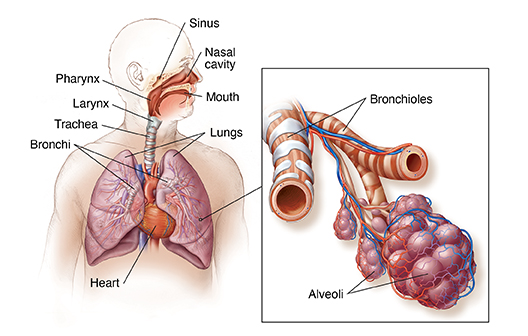
Lungs
The lungs take in oxygen. Your body's cells need oxygen to live and carry out their normal functions. The lungs also get rid of carbon dioxide, a waste product of the cells.
The lungs are a pair of cone-shaped organs made up of spongy, pinkish-gray tissue. They take up most of the space in the chest (thorax).
The lungs are surrounded by a membrane (pleura).
The lungs are separated from each other by the mediastinum, an area that contains the:
-
Heart and its large vessels
-
Trachea
-
Esophagus
-
Thymus gland
-
Lymph nodes
The right lung has three sections, called lobes. The left lung has two lobes. When you breathe in:
-
Air enters your body through your nose or mouth.
-
Air then travels down the throat through the larynx and trachea.
-
Air goes into the lungs through tubes called main-stem bronchi.
One main-stem bronchus leads to the right lung and one to the left lung:
-
In the lungs, the main-stem bronchi divide into smaller bronchi.
-
The smaller bronchi divide into even smaller tubes (bronchioles).
-
Bronchioles end in tiny air sacs (alveoli) where the exchange of oxygen and carbon dioxide occurs.
You then breathe out carbon dioxide.
Featured in
Online Medical Reviewer: Deborah Pedersen MD
Online Medical Reviewer: Jessica Gotwals RN BSN MPH
Online Medical Reviewer: Tennille Dozier RN BSN RDMS
Date Last Reviewed: 07/31/2023
© 2000-2026 The StayWell Company, LLC. All rights reserved. This information is not intended as a substitute for professional medical care. Always follow your healthcare professional's instructions.
Personalized care starts with the right provider
Search by specialty, location, and more.
FIND A DOCTORRelated Articles
Anatomy of the Respiratory System in Children
A detailed anatomical description of the respiratory system, including simple definitions and labeled, full-color illustrations.
Car Seat Safety and Distracted Driving
Detailed information on car safety.
A Simple Way to Keep the Flu Away
You can prevent the flu this season by taking one simple step: Get a flu shot.
Air Filters, Dehumidifiers, and Humidifiers
Here are some helpful tips for understanding the air in your house and the air-quality appliances that can alter it.