To diagnose and check asthma, your doctor examines you. They listen to your lungs in your chest and ask you to breathe. You are asked questions about your symptoms, triggers, and any family history of asthma or allergies. Lung function tests may also be done. One of these is a spirometry test.
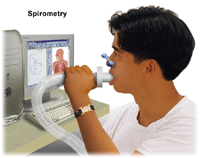
Spirometry is an easy test. It tells your doctor how well your lungs are working. The test generally takes 15 to 30 minutes. It can be done at a doctor's office or in a pulmonary function lab. Spirometry is rarely used for children younger than 6 years.
Your doctor will tell you any special directions before the test. They may tell you to stop taking certain medicines, not smoke, or not eat a large meal beforehand. Wear loose, comfortable clothing that allows you to take a big breath.
A trained technician will help with the test. You will sit upright. A nose clip will be placed on your nose so you only breathe through your mouth. You will put your mouth around a mouthpiece that is connected to the spirometer.
The spirometer measures the amount of air you breathe out (exhale). It also measures how quickly you can exhale completely.
Spirometry is a recommended test for people with asthma. It can help with the following:
|
What does it do? |
When is it usually done? |
|
It helps diagnose asthma. |
It may be used when your doctor is making a diagnosis. |
|
It determines a person’s response to treatment. |
It may be used after treatment is started and symptoms are more stable. |
|
It can find out how severe asthma is. |
It may be used during episodes that get worse or are severe. |
|
It is used to check asthma. |
It should be done at least every 1 to 2 years. |
What does the spirometer measure?
It can take a few different measures of your breath:
-
FVC (forced vital capacity). This is the total amount of air you exhale in a single, long breath.
-
FEV1 (forced expiratory volume in one second). This is the amount of air you exhale in the first second.
-
FEV1/FVC. This is the amount of air exhaled in the first second compared to the total amount of air exhaled. It’s given as a fraction or a percentage. In general, the higher the FEV 1/FVC, the better. Normal values depend on your age.
-
PEF (peak expiratory flow). This is a measure of how fast you can exhale. It can be tested with a spirometer or a peak flow meter.
Talk with your doctor about your test results and what they mean. If you haven’t had a spirometry test in a year or two, ask your doctor if you should have it done again.
Featured in
Date Last Reviewed: 08/31/2025
© 2000-2026 The StayWell Company, LLC. All rights reserved. This information is not intended as a substitute for professional medical care. Always follow your healthcare professional's instructions.
Personalized care starts with the right provider
Search by specialty, location, and more.
FIND A DOCTORRelated Articles
Asthma Management: The Mold Allergen
Mold can affect people with asthma; watch how you can reduce it in and around your home.
Work-Related Asthma
You may get work-related asthma by breathing in irritants at work. The symptoms may go away when you're not at work. But long-term exposure can cause lasting damage.
Your Health Checklist: Managing Sick Days
Follow this checklist to help you manage your asthma on days when you are sick.
Questions About Asthma Medicine
Read on for helpful answers to some common questions about asthma medicines.