-
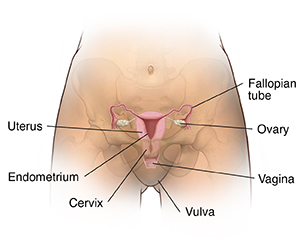
Endometrium. The lining of the uterus.
-
Uterus. Also called the womb, the uterus is a hollow, pear-shaped organ located in a person's lower abdomen, between the bladder and the rectum.
-
Ovaries. Two female reproductive organs located in the pelvis.
-
Fallopian tubes. Carry eggs from the ovaries to the uterus.
-
Cervix. The lower, narrow part of the uterus (womb) located between the bladder and the rectum. It forms a canal that opens into the vagina, which leads to the outside of the body.
-
Vagina. The passageway through which fluid passes out of the body during menstrual periods. It's also called the "birth canal." The vagina connects the cervix (the opening of the womb, or uterus) and the vulva (the external genitalia).
-
Vulva. The external portion of the female genital organs.
Featured in
Online Medical Reviewer: Donna Freeborn PhD CNM FNP
Online Medical Reviewer: Heather M Trevino BSN RNC
Online Medical Reviewer: Irina Burd MD PhD
Date Last Reviewed: 12/31/2022
© 2000-2026 The StayWell Company, LLC. All rights reserved. This information is not intended as a substitute for professional medical care. Always follow your healthcare professional's instructions.
Personalized care starts with the right provider
Search by specialty, location, and more.
FIND A DOCTORRelated Articles
The Menstrual Cycle: An Overview
A woman is generally most fertile (able to become pregnant) a few days before, during, and after ovulation.
Robotic-Assisted Myomectomy
A robotic-assisted myomectomy is a type of surgery. It is done to remove growths in a woman’s uterus called fibroids.
Amenorrhea
Amenorrhea means you haven't had your period for more than three cycles. It can be caused by a variety of things including overexercising, being overweight, or due to an ovulation problem.
Contraception/Birth Control
You have a lot of choices when it comes to birth control. Some methods don't need a healthcare provider's visit. But others, like oral contraceptives, are available only by prescription.