Definition
Anatomy of the Knee
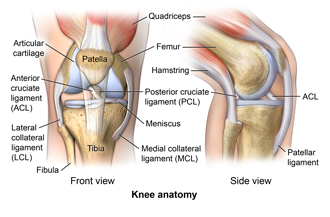
The knee is a vulnerable joint. It bears a lot of stress from everyday activities, such as lifting and kneeling. It also bears stress from high-impact activities, such as jogging and aerobics.
The knee is formed by the following parts:
-
Tibia. Shin bone or larger bone of the lower leg.
-
Fibula. Smaller of the 2 lower leg bones.
-
Femur. Thighbone or upper leg bone.
-
Patella. Kneecap.
Each bone end is covered with a layer of cartilage that absorbs shock and protects the knee. Basically, the knee is 2 long leg bones held together by muscles, ligaments, and tendons.
There are 2 groups of muscles involved in the knee:
-
Quadriceps muscles. These are on the front of the thighs. They work to straighten the legs.
-
Hamstring muscles. These are on the back of the thighs. They bend the leg at the knee.
Tendons are tough cords of tissue that connect muscles to bones. Ligaments are elastic bands of tissue that connect bone to bone. Some ligaments on the knee provide stability and protection of the joints. Other ligaments limit forward and backward movement of the tibia or shin bone.
Online Medical Reviewer: Rahul Banerjee MD
Online Medical Reviewer: Raymond Turley Jr PA-C
Online Medical Reviewer: Stacey Wojcik MBA BSN RN
Date Last Reviewed: 12/31/2022
© 2000-2026 The StayWell Company, LLC. All rights reserved. This information is not intended as a substitute for professional medical care. Always follow your healthcare professional's instructions.
Relief starts here
From sports injuries to joint replacement—we've got you covered.
FIND AN ORTHOPEDIC SPECIALIST
Personalized care starts with the right provider
Search by specialty, location, and more.
FIND A DOCTORRelated Articles
Anatomy of the Foot
Your feet are susceptible to many stresses. Foot pain and problems can cause pain, inflammation, or injury.
Anatomy of the Male and Female Pelvis
The pelvis is a basin-shaped structure that supports the spinal column and protects the abdominal organs.
Anatomy of the Shoulder
The shoulder is a complex joint with several layers, including bones, ligaments, tendons, and muscles.
Anatomy of the Spine
Your backbone, also called the vertebral column, is made up of 33 vertebrae separated by spongy disks.