Facts about the shoulder
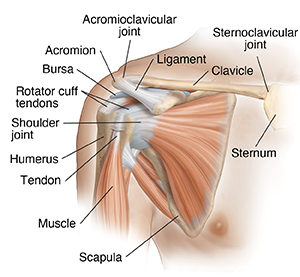
The shoulder is made up of several layers:
-
Bones. These include the collarbone (clavicle), the shoulder blade (scapula), and the upper arm bone (humerus).
-
Joints. These facilitate movement and include the following:
-
Sternoclavicular joint. This is where the clavicle meets the sternum.
-
Acromioclavicular (AC) joint. This is where the clavicle meets the acromion.
-
Shoulder joint (glenohumeral joint). A ball-and-socket joint that facilitates forward, circular, and backward movement of the shoulder.
-
-
Ligaments. White, shiny, flexible bands of fibrous tissue, which hold joints together and connect the various bones, including the following:
-
The joint capsule is a group of ligaments that connect the humerus to the socket of the shoulder joint on the scapula to stabilize the shoulder and keep it from dislocating.
-
Ligaments that attach the clavicle to the acromion
-
Ligaments that connect the clavicle to the scapula by attaching to the coracoid process
-
-
Acromion. The roof (highest point) of the shoulder that is formed by a part of the scapula.
-
Tendons. The tough cords of tissue that connect muscles to bones. The rotator cuff tendons are a group of tendons that connect the deepest layer of muscles to the humerus.
-
Muscles. These help support and rotate the shoulder in many directions.
-
Bursa. A closed space between 2 moving surfaces that has a small amount of lubricating fluid inside; located between the rotator cuff muscle layer and the outer layer of large, bulky muscles.
-
Rotator cuff. Composed of tendons, the rotator cuff and associated muscles hold the ball tightly within the glenohumeral joint at the top of the upper arm bone (humerus).
Facts about the spine
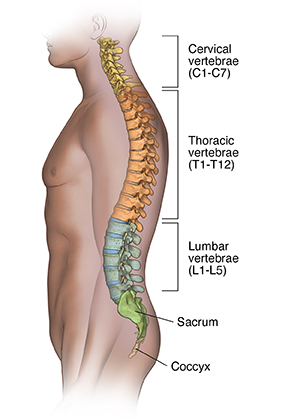
The vertebral column, also called the spine or backbone, is made up of multiple vertebrae that are separated by spongy disks. The spine is classified into several distinct areas:
-
The cervical area consists of 7 bony parts in the neck.
-
The thoracic spine consists of 12 bony parts in the back area.
-
The lumbar spine consists of 5 bony segments in the lower back area; 5 sacral* bones; and 4 coccygeal* bones (the number of coccygeal bones can vary from 3 to 5). (* By adulthood, the 5 sacral vertebrae fuse to form one bone, and the 4 coccygeal vertebrae fuse to form one bone.)
Facts about the pelvis
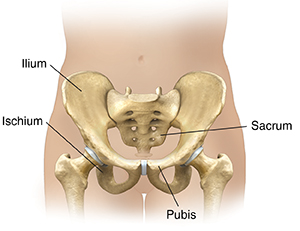
The pelvis is a basin-shaped structure that supports the spinal column and protects the abdominal organs. It contains the following:
-
Sacrum. A spade-shaped bone that is formed by the fusion of 5 originally separate sacral vertebrae.
-
Coccyx (tailbone). This is formed by the fusion of 4 originally separated coccygeal bones.
-
Pelvic (hip) bones. These are:
-
Ilium. This is the broad, flaring portion of the pelvis.
-
Pubis. This is the lower, front part of the pelvis.
-
Ischium. This is the part of the pelvis that forms the hip joint.
-

Relief starts here
From sports injuries to joint replacement—we've got you covered.
FIND AN ORTHOPEDIC SPECIALIST
Personalized care starts with the right provider
Search by specialty, location, and more.
FIND A DOCTORRelated Articles
What Is Basal Joint Arthritis?
Basal joint arthritis often affects the joint at the base of the thumb, the basal joint.
Anatomy of a Joint
Joints are the areas where 2 or more bones meet. Most joints are mobile, allowing the bones to move.
Lisfranc Joint Injury
A Lisfranc joint injury is a type of injury to the bones or ligaments in the middle part of your foot. In this type of injury, there also is usually damage to the cartilage covering these bones.
Osteoid Osteoma
An osteoid osteoma is a type of bone tumor. It isn't cancer (benign). It stays in the same place that it starts. It won't spread to other bones or parts of your body. Read on to learn more.