What is an arthroscope?
An arthroscope is a small tube that is inserted into the body. It contains a system of lenses, a small video camera, and a light for viewing. The camera is connected to a monitoring system that lets a surgeon view the surgery while it's being done. The arthroscope is often used with other tools that are put through another cut or incision. These tools are used for grasping, cutting, and probing.
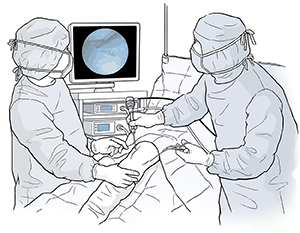
What is arthroscopy?
Arthroscopy is a procedure used for joint conditions. Originally, arthroscopy was used mainly for planning a standard open surgery. But with new tools and advanced surgical methods, many conditions can also be treated using an arthroscope.
What happens during arthroscopic surgery?
Each procedure will vary. But generally, arthroscopic surgery follows this process:
-
You will receive a general, local, or spinal anesthetic.
-
A small incision is made in your skin.
-
The arthroscope is inserted through the incision.
-
Other incisions may be made to introduce other small grasping, probing, or cutting tools.
-
Light is sent via fiber optics at the end of the arthroscope.
-
Information about the inside of the joint is sent to a screen.
-
Corrective surgery, if needed, may be done during the initial diagnostic procedure.
-
Stitches (sutures) with dressings or bandages may be put on the incisions.
The small puncture wounds created by the arthroscope and probing tools may take several days to weeks to heal.
Recovery time varies. But most arthroscopic surgery is done on an outpatient basis. This means you can go home within hours after the surgery. Some people get back to their normal activity in a few days or weeks. Athletes and other people in good physical condition may return to athletic activities in a few weeks, under the care of their doctor.
Joints most often examined with arthroscopy
The joints most often examined using arthroscopy include the:
-
Knee.
-
Shoulder.
-
Elbow.
-
Ankle.
-
Hip.
-
Wrist.
Conditions most often found with arthroscopy
Conditions most often found during an arthroscopic procedure are:
-
Inflammation. This includes in the lining (synovium) of the knee, shoulder, elbow, wrist, or ankle.
-
Injuries. These include:
-
Rotator cuff tendon tears, impingement syndrome, and recurrent dislocations in the shoulder.
-
Meniscal (cartilage) tears, chondromalacia (wearing or injury of cartilage cushion), and ACL (anterior cruciate ligament) tears with instability in the knee.
-
-
Pieces of loose bone or cartilage. This is particularly in the knee, shoulder, elbow, ankle, or wrist.
Always see your doctor for a treatment recommendation based on your own condition.
Featured in
Date Last Reviewed: 04/30/2025
© 2000-2026 The StayWell Company, LLC. All rights reserved. This information is not intended as a substitute for professional medical care. Always follow your healthcare professional's instructions.
Relief starts here
From sports injuries to joint replacement—we've got you covered.
FIND AN ORTHOPEDIC SPECIALIST
Personalized care starts with the right provider
Search by specialty, location, and more.
FIND A DOCTORRelated Articles
Rotator Cuff Repair
The rotator cuff is made up of muscles and tendons that hold the shoulder in place. The rotator cuff can become injured or wear down with age. If injured, the rotator cuff may need surgery to repair it.
Knee Replacement Surgery
When your knee is badly damaged by disease or injury, a knee replacement may be considered. During knee replacement surgery, your joint surfaces are replaced by prostheses. These are plastic and metal parts that are used to replace your joint surfaces. Read on to learn more.
Achilles Tendon Repair Surgery
Achilles tendon repair surgery is a type of surgery to fix a damaged Achilles tendon. Learn more about the surgery, including why you might need it, what the risks are, how to get ready for it, and what happens during and after the surgery.
Carpal Tunnel Release
Carpal tunnel release is surgery to treat carpal tunnel syndrome. Learn why you might need this surgery, the risks, and what to expect if you have it done.