What is a torn meniscus?
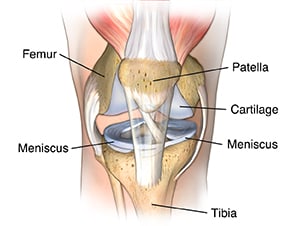
There are three bones in the knee. These are the femur, tibia, and patella. The ends of those bones are covered with cartilage. This is a smooth material that cushions the bone and allows the joint to move easily without pain. The cartilage acts as a shock absorber. Between the bones of the knees are two crescent-shaped disks of connective tissue, called menisci. These also act as shock absorbers to cushion the lower part of the leg from the weight of the rest of the body.
What causes a torn meniscus?
Meniscus tears can happen during a sudden rotating movement while bearing weight, such as when twisting the upper leg while the foot stays in one place during sports and other activities. This is known as a traumatic tear. Or meniscal tears can develop over time (degenerative). This is when routine activities, such as jogging or yard work, cause tears in the meniscus that have been weakened over time because of age, arthritis, or other conditions. Degenerative meniscal tears are most common in adults older than 40. Tears can be minor, with the meniscus staying connected to the knee. Or they can be major, with the meniscus barely attached to the knee by a cartilage thread.
What are the symptoms of a torn meniscus?
Each person may have different symptoms. But the most common symptoms are:
- Pain, especially when holding the knee straight
- Swelling and stiffness
- Knee may catch, click, or lock
- Knee may feel weak or unstable
- Less range of motion
These symptoms may look like other health conditions or problems. Always talk with your doctor for a diagnosis.
How is a torn meniscus diagnosed?
Your doctor will ask about your medical history and do a physical exam. You may also need:
- X-ray. This test uses invisible electromagnetic energy beams to make images of internal tissues, bones, and organs onto film.
- MRI. This test uses a combination of large magnets, radio waves, and a computer to make detailed images of organs and structures within the body. It can often find damage or disease in a surrounding ligament, tendon, bone, or muscle.
How is a torn meniscus treated?
Treatment will depend on your symptoms, age, and general health. It will also depend on your usual activity level and how severe the condition is.
Treatment may include:
- Resting, icing, and elevating your knee
- Compression bandage
- Medicine to relieve pain and reduce inflammation, such as ibuprofen
- Muscle-strengthening exercises
- Physical therapy
- Surgery
What are possible complications of a torn meniscus?
An untreated torn meniscus can result in instability of the knee and lasting pain. It can also increase your risk of osteoarthritis.
When should I contact my doctor?
Contact your doctor if your knee:
- Locks or catches or makes a clicking, popping, or grinding sound
- Is painful and swollen
- Feels weak or buckles
Key points about a torn meniscus
- Torn meniscus is often caused by a twisting movement of the knee while bearing weight. Or it can develop over time from routine activities.
- A torn meniscus causes pain, locking, or clicking, and weakness of the knee.
- Exercises, medicine, and surgery may be used to treat a torn meniscus.
Next steps
Tips to help you get the most from a visit to your doctor:
- Know the reason for your visit and what you want to happen.
- Before your visit, write down questions you want answered.
- Bring someone with you to help you ask questions and remember what your doctor tells you.
- At the visit, write down the name of a new diagnosis, and any new medicines, treatments, or tests. Also write down any new instructions your doctor gives you.
- Know why a new medicine or treatment is prescribed, and how it will help you. Also know what the side effects are and when they should be reported.
- Ask if your condition can be treated in other ways.
- Know why a test or procedure is recommended and what the results could mean.
- Know what to expect if you do not take the medicine or have the test or procedure.
- If you have a follow-up appointment, write down the date, time, and purpose for that visit.
- Know how you can contact your doctor if you have questions, especially after office hours or on weekends and holidays.
Online Medical Reviewer: Rahul Banerjee MD
Online Medical Reviewer: Raymond Turley Jr PA-C
Online Medical Reviewer: Rita Sather RN
Date Last Reviewed: 08/31/2023
© 2000-2026 The StayWell Company, LLC. All rights reserved. This information is not intended as a substitute for professional medical care. Always follow your healthcare professional's instructions.
Relief starts here
From sports injuries to joint replacement—we've got you covered.
FIND AN ORTHOPEDIC SPECIALIST
Personalized care starts with the right provider
Search by specialty, location, and more.
FIND A DOCTORRelated Articles
Boxer’s Fracture
A boxer's fracture is a break in the neck of the fifth metacarpal bone in the hand. It gets its name because the injury is common in boxers who are less experienced. Learn more about boxer's fracture, including symptoms, diagnosis, and treatments.
Fractures
A fracture is a partial or complete break in the bone. Read on for details about causes, symptoms, and treatment.
Patellar Tendonitis (Jumper's Knee)
Jumper's knee is caused by overuse of your knee joint, such as frequent jumping on hard surfaces. It's usually a sports-related injury, linked to leg muscle contraction and the force of hitting the ground.
Soft-Tissue Injuries
Detailed information on the most common types of soft-tissue injuries.