Genes are inherited from our biological parents in specific ways. One of the basic patterns of inheritance of our genes is called X-linked dominant inheritance.
What is X-linked dominant inheritance?
X-linked dominant inheritance occurs when a gene responsible for a trait or disorder is located on the X chromosome. The gene acts in a dominant manner. This means that both males and females can display the trait or disorder when they have only one copy of the gene inherited from a parent.
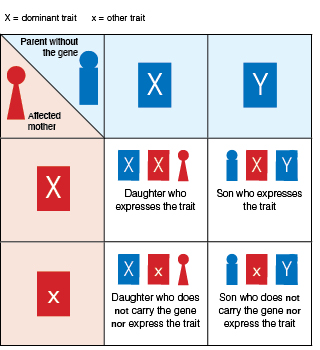
Depending on the disorder, a gene that is X-linked dominant may cause a pregnancy with a male not to survive. Scientists and healthcare providers say that there is "lethality" in males. This means that the gene can be passed from mother to daughter, but if it is passed to a son, the pregnancy likely ends up as a miscarriage. Only those sons without the gene survive and are born healthy. One example of an X-linked dominant condition is called incontinentia pigmenti (IP).
What is incontinentia pigmenti?
IP is extremely rare. The main features occur in the skin. It is seen more often in females. In newborns, a blistering rash occurs. This is followed by the blisters becoming raised, like warts. Next, brown swirls appear in the skin, followed by the appearance of light-colored swirls. The result is a "marble-cake–like" appearance on the skin. Other health problems can be seen in IP involving the eyes, central nervous system, teeth, nails, and hair. The severity varies from person to person.
Featured in

Personalized care starts with the right provider
Search by specialty, location, and more.
FIND A DOCTORRelated Articles
Fanconi Anemia in Children
Fanconi anemia is a blood disorder. With this condition, the bone marrow doesn't make enough blood cells. Or it makes abnormal blood cells.
22q11.2 Deletion Syndrome in Children
22q11.2 deletion syndrome is a genetic disorder that can cause many health problems. These problems may range from heart defects and developmental delays to seizures.
Congenital Aortic Stenosis Surgery for Children: Ross Procedure
A Ross procedure is a type of surgery. It fixes a birth defect in the heart that affects the aortic valve.
Addison Disease in Children
Addison disease is when the adrenal glands don't make enough of two steroid hormones. The hormones are cortisol and aldosterone. Cortisol controls the body's metabolism, blocks inflammatory reactions, and affects the immune system. Aldosterone manages sodium and potassium levels. Addison disease is fairly rare and may first appear at any age.